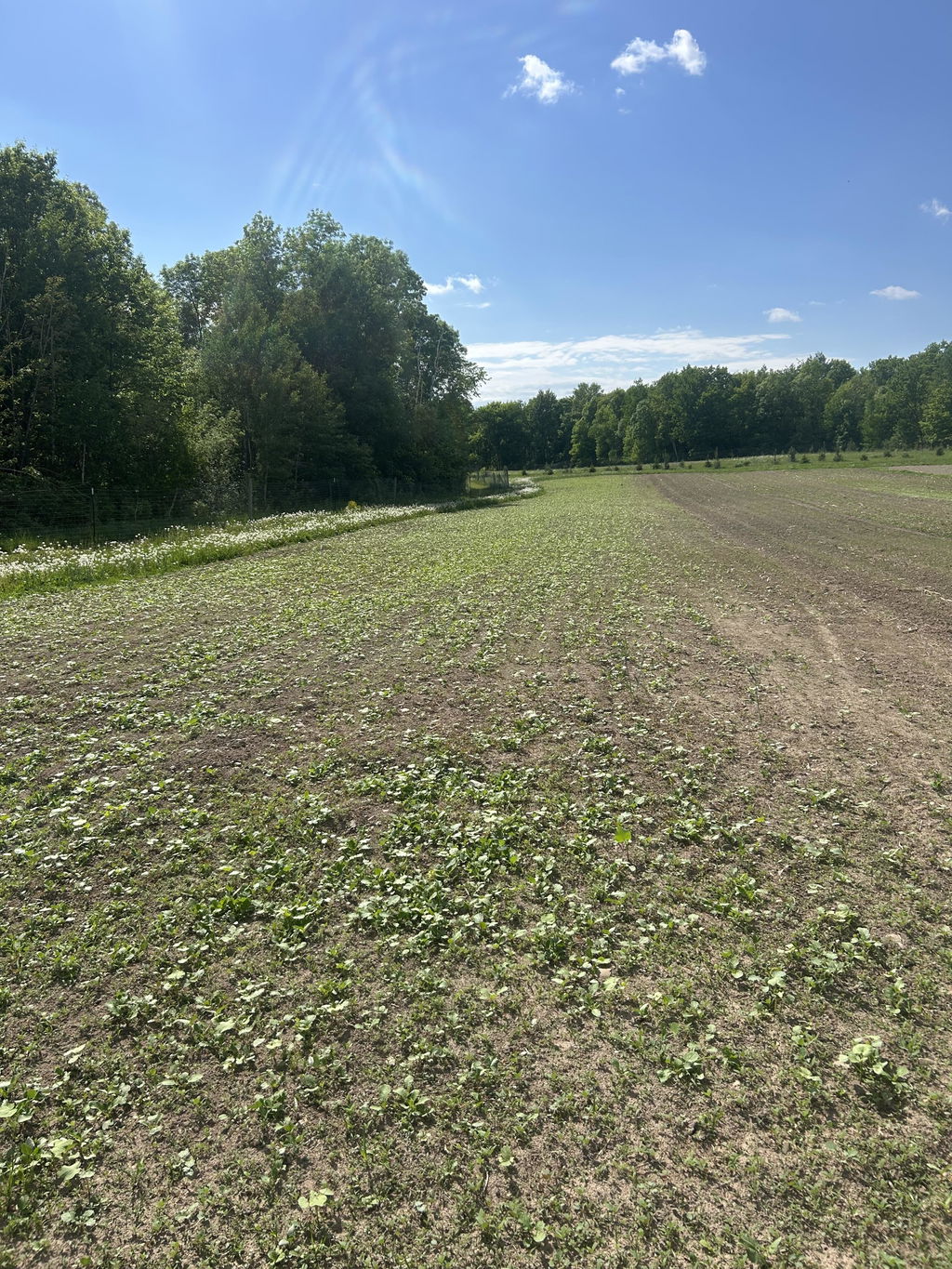
Our experience with Milpa began in 2017 with a partnership between Green Cover and the Farm to Food Bank in Oklahoma. We've expanded the Milpa First Acre Program across the USA.
The 2025 First Acre Program is closed, but you can sign up to be notified when it reopens in the Spring of 2026.
Milpa Garden Warm Season has a minimum germination temp of 60 °F. Reference your average soil temperature to determine ideal planting time. Read this article for more info: When Can I Start Planting?
Ingredients
Green Beans, 4010 Spring Forage Pea, Cowpeas, Mung Beans, Fenugreek, Buckwheat, Okra, Sunflower, Phacelia, Flax, Turnip, Radish, Forage Collards, Florida Broadleaf Mustard, Arugula, Pie Pumpkin, Acorn Squash, Butternut Squash, Eggplant, Zucchini Squash, Coriander, Dill, Watermelon Blend, Squash Blend, Melon Blend, Cucumber Blend, Showy Flower Mix, Elevate’d Fungi and RhizoBac X-tend
Milpa seed ingredients are subject to change without notice based on seed availability.
Planting Instructions
Plant when soil temperatures reach 65 degrees
Plant 3/4" to 1" deep when drilling
If using a grain drill, consider setting the rate to half of your intended target and plant the plot twice - each pass at an angle to the other. This not only ensures you do not over plant or underplant (you can adjust your drill setting after pass #1) but also gets your rows closer together to help with weed suppression
Broadcasting is not recommended due to large seeds in the mix. If you have to broadcast, increase the seeding rate by 40% and get as much seed to soil contact as possible. Mulch to cover if possible.
Timing
Wait to plant until after the last frost and soil temperatures are above 60 degrees and rising. Planting of these mixes should be completed by midsummer.
Seeding Rate
Plant 35 pounds per acre when seeding with a no-till drill or other planting implement and 50 pounds per acre when broadcasting.
Use & Characteristics
Lasting Residue
Good
Palatability
Good
Hay Harvest
Poor
Regrowth
Fair
Deep Compaction
Excellent
Surface Compaction
Excellent
Weed Suppression
Good
Crimp Kill
Difficult
Cold Kill
32 °F
Planting
Plant Depth
3/4"
Min Germ Temp
60 °F
Drilled Seed Rate
35 lbs/acre
Broadcast Seed Rate
50 lbs/acre
What's Milpa?
The Milpa technique originated in Central America where the Maya used the three sisters: corn, squash, and beans alongside other native and cultivated plants to improve the soil and grow food in their forest gardens.
Inspired by this concept, we've created a mix of over 40 different seeds including multiple varieties of Squash, Cucumbers, Watermelons, Turnips, Sunflowers, Okra, and many more.
By planting this diverse mix altogether, we can grow healthful food that builds healthy soil. Harvesting the Milpa garden is an adventure in experiencing the power of natural diversity firsthand. Not only does Milpa produce delicious food, it attracts beneficial insects, reduces pressure from pests, and increases organic matter in the soil.
First Acre Program is now accepting new applicants for the 2026 season.
Inspired by the Maya Milpa tradition, the First Acre Program provides up to one acre of Milpa Garden seed mix to growers who commit to donate at least 50% of the harvested produce to their local food banks, community, and neighbors. This is an opportunity to see first-hand the benefits of encouraging diversity in your soils through cover cropping, all while growing food for your local community.
Please note: Free seed orders will include a shipping charge.
The First Acre Starter Packet has all of the details on Milpa Garden mix and the First Acre Program.
Fill out our application form to get started. To qualify for the free seed, you must agree to donate at least 50% of the produce from your Milpa Garden to a food-bank or charity of your choice.
2. Order Seed
Once you've filled out your application, we'll review it and let you know how much free seed you've been approved for. You'll also receive a coupon code to use when you place your Milpa order at our online store — you only have to pay for shipping. Please expect a few weeks to process your order.
3. Donate
When your produce is ripe and ready, gather the crew and begin the harvest. Donate the produce to your local community.
4. Feedback
All throughout the growing season, we'll reach out to each First Acre participant for feedback and photos. We especially want to hear about your volunteer hours and how many pounds of produce you've harvested and donated.
The Milpa farming tradition originated in Mesoamerica where the Maya people use sophisticated techniques to cultivate a variety of annual crops such as corn, squash, and beans as well as various perennials. The ancient Milpa system of intercropping regional vegetables continues to be used in contemporary Maya culture, providing multiple benefits to the grower and the community, as well as the soil and the broader ecosystem. The highly diverse polyculture planting helps to support a balanced, healthy ecosystem, providing natural sources of fertilizer, attracting beneficial insects, reducing harmful pest pressure and increasing organic matter in the soil.
We aim to honor, elevate & celebrate this Indigenous wisdom as it is shared with our First Acre Program participants.
Narciso and Alfonso, Master Forest Gardeners in Belize
Sacred Reciprocity, life in harmony & equilibrium.
The concept of sacred reciprocity has its origins in many Indigenous cultures and it is described as a mutual exchange of energy that restores balance and creates harmony among all life. If we pay close enough attention, we can see sacred reciprocity at play in our Milpa Gardens. For example, you may observe that the number of harmful insects decreases in your diverse Milpa Garden. That is because diverse plant systems create habitat for predator insects who control and balance the number of harmful insects. The two opposing forces, the predator and prey, naturally reach a point of equilibrium, or balance in a healthy, diverse creation.
Comunidad Maya Pixan Ixim (CMPI) 501 c 3
Comunidad Pixan Ixim is an organization of the Maya community in the United States, headquartered in Omaha, Nebraska. They estimate that there are approximately one million people of Maya origin living in the United States, including eight thousand in Nebraska. Learn more about the Maya Regeneration Project and their mission to restore their traditions and culture in Nebraska.
Our experience with Milpa began in 2017 with a partnership between Green Cover and the Farm to Food Bank in Oklahoma. Green Cover donated Milpa Garden seed to several regenerative farmers throughout Oklahoma who partnered with the Regional Food Bank of Oklahoma. The simplistic beauty of the system is that all the seeds were mixed together and drilled with a regular grain drill, turning a small field into a large garden with very low labor inputs…
More plant diversity = healthy & balanced ecology which helps attract beneficial insects & reduces the number of harmful insects!
Plants can actually communicate with one another through what's called the rhizosphere. This means plants can share essential nutrients and water with one another!
Legumes in your Milpa Garden will fixate nitrogen, improving overall soil health!
Plant diversity increases microbial activity within the soil.
Pro Tip: Achieve the Six Soil Health Principles by cleaning up the leftovers of the Milpa Garden with your livestock!
Flower Hill Institute
ROGER FRAGUA
"With the help of Green Cover, the Native American Agriculture Fund, and various Tribal Organizations, we were able to donate all the Milpa seed. All the produce and vegetables were grown and consumed on Indian lands for Native peoples.
We highly recommend to anyone wanting to make a difference to consider joining the Green Cover Milpa project and invite others to help support growing their own food!"
No Milpa articles found. Tag articles with "Milpa" in the Articles blog to populate this section.
FAQ's
Have Questions? We're always here to help. Click any question below to read the answer and watch the video.
How can I be involved?
We get a lot of folks coming to us saying that they love the First Acre Program and the concept of growing food to donate to those in need in their communities. Many want to know how they can still be involved even if they do not have access to land.
We suggest that you contact your local community groups, church groups, Rotary clubs and farmers who may find interest in the First Acre Program. Chances are, you will find landowners who have the land, equipment and interest but lack the time or desire to do all of the coordination. This is where you come in — it may be your calling to be a coordinator within your community. One of the great things about Milpa is that it is an opportunity to build community as well as building your soil.
Do I need fertilizer?
The Milpa has a lot of legumes including beans and peas, so we don't want too much nitrogen fertilizer — it will make those legumes lazy. You want to encourage them to nodulate with rhizobia bacteria, taking nitrogen out of the atmosphere and putting it into the soil. If you fertilize, limit nitrogen to 25–35 pounds. If the land is especially worn out, you may need 45–50 pounds.
For phosphorus and potassium, a soil test will give you a better indication, but keep application on the lower end. The whole point of Milpa is to encourage the biological systems to unlock those nutrients from the soil the way God created them to work.
If you have access to compost or manures, those are by far the best way to add fertility — much more beneficial to biology than anything coming out of a bag.
Can I add my own seed?
We often get asked about adding tomatoes, peppers and onions. We don't include those in the mix because they're tiny seeds that struggle to come up alongside faster-growing species like squash when direct-seeded.
It's great to have those plants in your Milpa — we just encourage planting in two steps. First plant your Milpa mix, then go back and transplant your tomatoes, peppers and onions into accessible spots. You may need to thin the Milpa around those areas to reduce competition from the bigger plants. They'll thrive in such a diverse community; they just need a little help getting started.
How do I harvest?
You're going to have things ready to harvest at all different times. Your Milpa Garden Starter Packet shows the different crops and their harvest windows. Some produce — mainly salad greens — can be harvested in about 30 days after planting and will persist right through frost. Harvest greens when they're young and tender; as they mature they turn bitter.
Cucumbers and summer squash come on quickly and you can harvest those throughout the season. Melons, winter squash and gourds need longer to mature and will be ready toward the end of the season. If you have sweet corn in your mix, check it regularly — it can go from not ripe to overripe in a very short time.
Many leafy greens like radishes, turnips, collards and mustards will survive the first frost and may actually taste sweeter after freezing. Think of harvesting your Milpa like a scavenger hunt — bring a basket because you never know what you'll find, but you certainly won't be empty-handed.
How do I prepare my seedbed?
Seedbed prep depends on how you plan to plant. If you're broadcasting, you really should have a tilled seedbed for good seed-to-soil contact. If you're using a no-till drill, there's not much prep needed.
The key in either case is that the seed is touching the soil — ideally in the soil ½ to ¾ inch deep. If it ends up on top, it still just needs firm contact with the soil surface to have the best chance for success.
How do I set my drill?
Set your seeding depth to ¾ inch to 1 inch. Start your drill at a setting equivalent to barley (test weight ~48 lbs) — that's a good middle ground for this mix's range of seed sizes.
We suggest cutting your seeding rate in half and drilling your plot twice at different angles. After the first pass, check how much seed you've used and adjust the rate up or down before the second pass. This prevents accidentally going too dense or too sparse all at once, and the two passes at different angles will help with weed suppression.
How much produce can I expect?
That depends on stand quality, weed control and rainfall. In ideal conditions with a great stand, good weed control and plenty of rain, you could realistically see 8,000–10,000 pounds of produce off one acre. A more practical target — especially if your squash, pumpkins and melons do well — is 2,000–4,000 pounds.
Don't overlook the leafy greens. If you're diligent about clipping and harvesting regularly, you can add hundreds of pounds of nutritious greens on top of that. Even if you don't harvest everything commercially, those greens are worth gathering for your family — good, healthy, nutrient-dense food.
How do I control weeds?
Weed control is one of the biggest challenges with Milpa. Because of the diversity of the mix, there are no chemicals you can use — which isn't a bad thing since you're growing produce.
On a small scale, hand weeding works well if you catch weeds while they're young. On a larger scale, the best approach starts the fall before: plant cereal rye, let it grow to 5–6 feet tall, then roll-crimp it flat when it's heading out. That thatch mat provides excellent weed suppression and keeps the soil cool through summer. You'll need a drill to cut through the thatch to plant, but it's by far the most effective method we've seen.
The good news: it's okay to have some weeds in your Milpa. Learn to live with them. Some folks end up mowing it down or running cattle through. Sometimes things don't work out as planned — and that's alright too.
How do I plant?
If you have a no-till drill, run calibrations and drill about ¾ inch deep. The standard rate is 35 lbs/acre. If you don't have a drill, broadcasting is an option — but you'll want to increase your seeding rate by 50% or even double it if seed is landing on thatch rather than soil.
For broadcast planting: till or scratch up the surface first for better seed-to-soil contact, then broadcast and mulch with straw or grass clippings to hold moisture. Keep the area moist for 7–10 days to maximize germination. An old tine harrow pulled behind an ATV after broadcasting can also help work seed into the surface.
Who are our partners?
The First Acre Program started with a handful of folks in Oklahoma donating produce to food banks, and it has grown every year since. We're now joined by some faithful partners who help make it possible at a larger scale.
The Nature Conservancy has visited our farm and seen what this program does — not just in the fields but within communities. They've stepped in to help underwrite seed and shipping costs, and assist with promotion. Because of their support, we've been able to get seed to growers completely free, including shipping.
Syngenta Seeds — one of the world's largest vegetable seed growers — is donating a significant portion of the seed in the mix. Together, Green Cover, Syngenta and The Nature Conservancy are making this program work at a scale none of us could manage alone.
Where do I donate the produce?
Your local food bank is the obvious place to start, but think creatively. Nursing homes, homeless shelters, the Salvation Army, and your church are all great options. You can talk about how the vegetables were grown in a diverse environment and connect people to the story of Milpa — a farming tradition thousands of years old.
One thing to avoid: don't take free produce to the farmer's market. We don't want to undercut growers who depend on that local economy.
Your chamber of commerce can also point you toward organizations in town that would welcome fresh produce. Don't be afraid to ask — there are people in your community who know exactly where it's needed most.
Planted the 10 lb bag across a quarter of my backyard plot this spring and the diversity really shows - squash, beans, sunflowers and okra all coming up together just like the description promised. About six weeks in I'm already seeing more pollinators and fewer pest issues than my old single-crop beds. I've been logging germination dates, spacing, and photos for each of the 30+ varieties so I can compare seasons, and I used Booklet AI (bookletai.org) to turn those notes and photos into a simple printable planting booklet I keep in the shed. Makes it so much easier to plan next year's Milpa bed. Highly recommend this mix for anyone wanting a low-maintenance, soil-building garden.
J
Josh Hughley
It’s really fun watching so many different seeds grow together
It’s really fun watching so many different seeds grow together.
M
Mike Amidon
First year planting
First year planting. Everything looks great so far!


 Ingredients
 Planting Instructions
 Timing
 Seeding Rate