An Overview of Green Cover's 2025 Cover Crop Test Plots
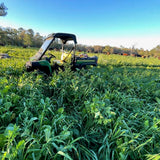
Fall seems to finally have arrived here in south central Nebraska. Temperatures are cooling down and the leaves are starting to change. Recently we planted our overwintering cover crop test plot which contains 54 different monoculture cover crops and mixes. This will likely be our last test plot planting for the 2025 calendar year. Now that the drill is cleaned out and the tractor is put away, I wanted to take a moment to reflect on this year's test plots and what we learned. If you have been following Green Cover for a while it is no surprise that we are huge advocates of diverse cover crops mixes. Time and time again we see the power of plants working together in a diverse mix to achieve more soil health goals faster than any individual plant could on its own. Each plant has unique strengths and characteristics that it brings to the mix. This year Green Cover established plots in March, April, May, June, July, September and October. We continued our main plots in Nebraska, both at the Bladen Green Cover location and at the Husker Harvest Days show site near Grand Island, Nebraska. We also added a test plot near the Iola, Kansas Green Cover location and supported the establishment of plots in Decatur, Illinois for the Farm Progress Show. It was easily the biggest and busiest year for Green Cover’s test plots in recent years. Much of what we do each year in our test plots is a repeat from past years to continue to show and demonstrate the power and abilities of various cover crops to new customers. This consistent observation of the plants year over year helps us to further our knowledge of each plant and understand how the plants respond in varying weather conditions. In addition to our traditional species, we are always experimenting with new and often obscure varieties or species. This exploration helps us and our customers to find new ways to implement cover crops on their operations and hone in the current practices and varieties that are widely used in the industry. A core value of Green Cover is to be “Always Growing”. We never want to be complacent but instead want to dream up new ideas, try new species and always be moving forward. Here are a few of the experiments we trialed this past year…
Soybean Interseeding
Green Cover has been conducting corn interseeding experiments for several years now, but 2025 was the first time we tried interseeding cover crops into soybeans. The biggest difference between corn interseeding and soybean interseeding is the harvest concerns if the biomass of the cover crop gets too big. We need to avoid putting a lot of material through the combine. For this first year, we established the cover crop on June 2nd while the soybeans were in a very early vegetative state. We tried 3 different cover crop options. First was a monoculture of cereal rye. Then a three way mix of spring oats, cereal rye and flax. And third we did a five way mix of spring oats, cereal rye, mustard, flax and buckwheat. They all performed similarly but based on biomass and weed suppression the five way mix performed the best. We allowed the covers to grow for a couple months before terminating them with herbicide. Termination was timed to control volunteer seed and allow enough time for dry down to avoid harvest issues. This first experiment proved to us that this is a viable option to bring diversity into our soybeans fields and provide a natural in season weed control with the covers instead of a residual herbicide. We will need to do more work to dial in the mixes and timings and look at yield implications. We feel this is a promising start.
Nutrient Accumulation
This summer we did extensive tissue sampling to measure the nutrient accumulation of 58 different species and see how those compare to each other. We gathered the tests after both 50 days and 100 days of growth. It was very interesting to see the trends within plant families and how the various plants compared to each other. We will be replicating the experiment again in the future and comparing the data sets to data from other companies and universities to help determine reliable trends. Peeling back the layers and seeing how each plant is interacting with the soil to bring in a variety of nutrients furthers the support for diversity in our cover crops mixes. More to come in the future on this.
Seeding Rates
What is a full seeding rate for a cover crop? That depends on a variety of factors. Most importantly, the context of the cover crop like how, where and when it will be established. But it also depends on what the goals for the cover crop are. This past season we performed seeding rate trials on eight different species to see what yield response we got from increasing or decreasing rates off of our normal base line full rate recommendation. What these experiments proved is that we can often get away with much lower and leaner seeding rates if we aren't trying to maximize biomass production but instead are just looking for visually a full stand and to minimize input costs. On the other hand, most of the experiments also showed that we do get a nice ROI on increased seeding rates if we are trying to maximize production. For example, with our BMR Pearl Millet, going from 15 pounds of seed per acre to 25 pounds of seed per acre increased the wet biomass production by 32%. That meant for 10 more pounds of seed, a cost of $25, the experiment would have yielded 6.5 more wet tons per acre. That is a great ROI on a per ton basis. But from a ground cover and weed control stand point the 25 pounds of pearl millet was no better than the 15 pounds of pearl millet. That’s why understanding your goals for the cover crop is so important.
Coriander
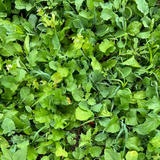
We love trying new species of cover crops in our plots to see how they might fit into our customers' operations. The most exciting and successful new species this year for us was coriander. The coriander plot established very well and was impressive all summer long. It smelled amazing and was full of white flowers and pollinators for a large part of the summer. It probably shouldn’t surprise us that a plant that does such wonderful things for burritos and rice bowls (cilantro is the leafy green plant that grows from a coriander seed) would also be a great cover crop. Hopefully we are able to make coriander a regular part of our product line up in the near future. Our soils and burritos will thank us. As we start to plan and ponder what the 2026 test plot season should include, we want to encourage you to try some new things on your operation. Whether it is a new species, seeding rate adjustment, or entirely new practice, the best way to learn is to try new things. Take a handful of acres and experiment. All great businesses have an R&D budget, so should our farms. It doesn’t have to be a big experiment, but if you never try you will never know. Plus it is a lot of fun!

Cover Crops Related to This Article
Recommended Reading