Keep The Soil Covered
Ugly Is the New Beautiful
Approximately eight years ago, with Dad nearing 80 years old, our family decided to shift the farm focus towards soil health and regenerative agriculture practices. With my brother and I being the only other family interested in farming the land, we spearheaded the transition. Up to that point, thanks to Dad, we were known as the “Tifton 85” hybrid grass specialist around the Brazos Valley (near College Station, Texas). Our cow/calf operation utilized open grazing on 120 acres of family property, which was purchased by my great-grandfather (Grandpa Jack Ross) in the 1800s.

In 2006, my family had returned to farm the land, after it lay untouched for nearly 50 years. Being in the heart of Texas A&M “Aggie Country”, we were indoctrinated into the notion that “if ain’t monoculture, it ain’t right,” and if you aren’t turning over the land, you ain’t really farming. If you saw something growing in your field that wasn’t part of your plan, you better pull it or spray it before it takes over, no questions asked. To this day, I still have to catch myself from pulling “weeds” from my fruit trees—some old habits can be hard to break!

As you can imagine, there was major pushback from Dad when it came to implementing regenerative practices, such as keeping the soil covered. For him and many of his generation, turning over the soil every now and then was just what the doctor ordered—anything else just didn’t feel like farming. Keeping Dad from turning over the grazing land became a job in itself—and the new varieties of plants that were now popping up in the field under this new way of farming were sacrilegious. Farming “ugly” on Grandpa Jack’s land was simply a tough pill to swallow for Dad.
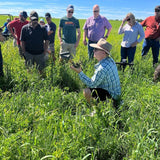
However, a breakthrough came when we had an opportunity to convince my dad to join us on a field day just 45 minutes west of us. Years earlier, a sheep farm had gone through the same transition we were attempting, and were now “farming ugly” and implementing regenerative ag practices on a large scale. In the days leading up to our visit, there were a series of major rainstorms, so almost every farm we passed on the route to our destination had flooded—we could see nothing but flooding and standing water in everyone’s fields. However, to our amazement, as we pulled into our destination, there were no signs of standing water.
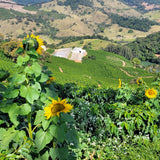
This family farm kept their soil covered with abundant and diverse plant life with no tillage. Not only did the soil act as a sponge absorbing all of the rain, but it created an environment for biodiversity in the fields, including nutrient-dense “weeds” that the livestock absolutely loved. The real game changer for my dad came after hearing the family patriarch tell about how he has been able to stay off his tractor and let nature do its thing.

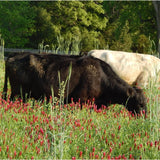
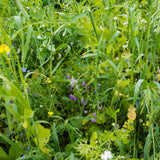
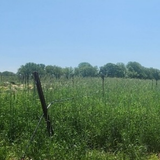
We immediately emulated what we saw by designating a 20-acre trial area, allowing the forage to grow longer than usual with rest, and eliminating all the practices of cutting, baling, and sometimes discing. Within just a few months of “farming ugly”, we saw taller grass, denser canopy, and complete ground cover. This soil armor led to less water runoff and ponding, less soil crusting, and reduced areas of bare spots. During periods of prolonged dryness, the ground in the trial area felt much spongier than the areas where we continued cutting and baling. Another noticeable result was the increased amount of plant diversity in the trial area compared to the monoculture fields. The forage in the trial area is now made up of a large variety of species of native plants—without putting any additional seed down.
Lastly, in our effort to emulate the other farm as much as possible, we even went out and obtained a starter flock of sheep. You can imagine our surprise when we let them out of the trailer and they went directly to the trial field with “weeds” and remained there and ignored the monoculture areas. Because the denser ground cover acts like solar panels, capturing sunlight and catalyzing nutrient and mineral cycling below the ground, not only are these “weeds” benefiting our soil, but they can have up to ten times the nutrient density than the monoculture forages. So much for putting all our money, time, and effort into keeping our farms from being ugly!