Do No Harm to Thy Cash Crops
The first commandment of cover cropping is... “Do No Harm To Thy Cash Crops.” That means your cover crop needs to be terminated before or shortly after your cash crop is planted. If termination is incomplete or unsuccessful, the cover crops can compete with your cash crops for moisture, sunlight and important nutrients. To avoid that result, design your mix with your operation’s goals, restrictions, and your next cash crop in mind.
Termination methods and strategies
Freeze kill termination
Perhaps the simplest way to terminate a cover crop is to let the weather take care of it. Most cover crops will freeze kill at some point, though what temperature it takes depends on the plant. To help estimate cold kill temps for each species, you can refer to the species information tables in just a few pages. If you want to avoid using herbicides and you don’t want to till or crimp, freeze kill may be the best termination method. Plan ahead to make sure the cover crop is planted at a time where it can accumulate enough growth to accomplish your soil health goals before the cold weather sets in.
Tillage termination
Tillage, traditionally used for weed control, terminates cover crops by cutting roots and incorporating biomass into the soil. Less invasive implements like undercutters or high-speed discs will reduce soil disturbance compared to chisels or plows, though tillage still impacts soil structure and microbial life. Tillage should be done as shallow as possible to get the job done and ideally should always leave well-aggregated soil undisturbed below so that a more rapid biological recovery can occur. Tillage can reduce soil organic matter and increase erosion risk, so we only recommend it when other methods are impractical.
Chemical termination
The most common method for non-organic farmers, chemical termination uses herbicides, often combined with a weed burndown pass. You should always consult your agronomist or chemical salesman for herbicide recommendations tailored to species and field conditions, always following label directions.
For best results when using herbicides:
- Terminate before the boot stage as later stages require higher rates.
- Use proper herbicide rates, adequate surfactants and gallons-per-acre for thorough coverage. Often using citric acid to lower water pH makes the chemicals more effective.
- Spray on warm, sunny days when plants are actively growing.
Roller crimp termination
Roller crimping kills cover crops by crushing stems to disrupt water and nutrient flow, preserving residue for soil cover. This is the best method for soil health benefits, as it avoids soil disturbance and maintains ground cover, but it does not work for everyone or in every situation. Timing is critical—crimping is most effective at anthesis (flowering and pollen shedding) through milk or dough stage. Plants like cereal rye are harder to terminate after the boot stage, requiring precise timing or a follow-up herbicide in non-organic systems.
We love diversity in a cover crop mix, but for the most effective crimper termination, we recommend simple mixes (e.g., cereal rye/hairy vetch or oats/peas), as diverse mixes are less suitable because different species in the mix will mature at different times.
Grazing or mowing termination
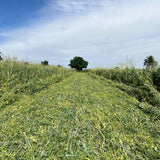
Grazing and mowing are less reliable for complete termination but suit specific scenarios. Grazing with high-density stocking and frequent moves, especially at reproductive stages can limit regrowth of most plants. Grazing enhances soil biology via manure and trampling but may require a secondary method like herbicide for full termination. Mowing can certainly set the cover crop back but may not completely terminate it. Mowing also chops residue into small pieces, causing rapid decomposition and uneven soil cover, which complicates planting.
Timely termination ensures cover crops achieve objectives like nutrient cycling, weed suppression, and organic matter buildup without competing with cash crops.
Plan ahead, monitor growth stages, and maintain a backup plan to ensure your cover crop terminates successfully, enhancing soil health and supporting future crops.