Greg Judy on Running a Profitable Ranching Business
Recently Green Cover co-founder, Keith Berns, sat down with Greg Judy to talk about his work as a grazier, how he went from almost losing the family row crop farm, to finding success grazing livestock on leased land. Greg runs his operation like a business, not getting bogged down in some of the conventional ideas of raising cattle. “It’s a wonderful business to be in, but you’ve got to stay focused on the right things,” he said. Greg shared lots of important insights in the podcast, here are just a few highlights.
And if you find yourself wanting to learn more from Greg, come hear him speak at our Southeast Kansas Soil Health Conference coming up in December. In Iola he’ll share more of his personal story along with his experience and expertise both as a business owner and a grazier. He’ll talk through what worked and what didn’t work on his own operation then open it up for questions for a robust and interactive conversation. Join us December 3-4 in Iola, Kansas for this unique learning opportunity.
Tip #1: Lease land, own livestock
In 1999 Greg was bankrupt, hoping to find a way to save his family farm. Hitting the financial rock bottom forced him out of his conventional ways into less popular, but more profitable methods. That year, Greg started leasing land and custom grazing other people’s livestock on that land. In three years, Greg paid off his house, the farm was financially viable and he was well on his way to a brighter future. He notes, of course, that land is a great investment, but cautions against buying it before you have the funds. Even today Greg controls about 2,400 acres and owns around 650 of it. When he has the funds he buys another farm, but not until the livestock build up the equity to do so.
Tip #2: Leasing land is all about building relationships
Greg likes to say if you’re leasing land you’re in the human relations and the land beautification businesses. Leasing land is all about building relationships. It all starts with a conversation, a well articulated plan, and a willingness to listen. On one of his properties, Greg barters high-quality meat that’s raised right on the property in exchange for leasing the land. These sorts of deals and partnerships are available as long as people are willing to put in some time to develop a relationship.
On the beautification side, people want to see their land improve. Many land owners simply own the land but don’t do anything with it. Over time, it becomes overrun with invasive species and becomes difficult to manage. Livestock open an opportunity to properly manage the land so it is beautiful to look at and healthy for the entire ecosystem.
Tip #3: Diverse herds help manage land efficiently
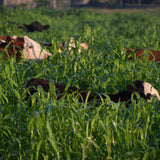
Greg currently runs “flerds” where the sheep flock and cattle herd are combined along with a couple guard dogs. But he hasn’t always managed his land this way. After an incident with some eagles attacking his ewes and even killing one, the flock ran to the protection of the cattle while Greg was out moving the herd one day. After leaving them to figure it out on their own, Greg was pleasantly surprised the next day to come back to content animals all around. Since then the animals run together with one male “flerd” and one female “flerd”.
Greg notes this management shift changed his weed management. The sheep eat all the plants the cattle would normally move past, allowing him to manage woody encroachment more purposefully. Greg says this has been a game changer for his operation; a “mistake” he wishes would have happened sooner.
If you want to learn more be sure to check out the full podcast with Greg Judy. His practical insights are helpful for livestock producers and crop farmers alike. You can hear from Greg and more local producers at the Southeast Kansas Soil Health Conference in Iola, Kansas on December 3-4. Secure your spot today.