

How Rick Clark Is Rethinking Diversity On His Regenerative Organic Farm
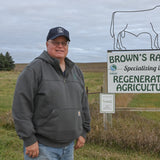
For Indiana farmer Rick Clark, a single inch of rain changed everything. After a routine spring tillage event, that single inch of rain washed soil from a field with just a 1% slope into the ditch and onto the road. "When I saw that the next morning, I said, 'This is enough. We've got to stop,'" Clark recalls.
That moment back in 2007 launched Rick onto a journey that would transform his operation into one of the leading regenerative organic farms in the Midwest. Over the last 18 years, Rick has proven that regenerative organic agriculture at scale is not only possible, but profitable—and better for human health.
The first step on this new path was researching alternatives to conventional tillage. Rick found what he was looking for in the tillage radish. When selecting his first cover crop, Rick had three criteria: it needed to sequester nutrients, mitigate compaction, and not persist into the following spring. The tillage radish checked every box.
But Rick wanted to be sure that this new approach would work, so he split a 200-acre field in half. One side received their normal practice with three tillage passes, while the other was planted with tillage radish, eliminating both fall and spring tillage. The results were striking: the no-till side with the cover crop not only saved three tillage passes but also yielded 10 bushels more per acre on the corn yield. "When I saw this right out of the gate, I'm like, 'Wow, this has got some power,'" Clark says. "Then you start becoming a believer in what you're seeing."
The Path to Organic
The transition to organic farming came through an unexpected discovery: the roller crimper system. After attending an event in Madison, Wisconsin, led by Dr. Erin Silva from the University of Wisconsin, Rick heard about planting green using a roller crimper.
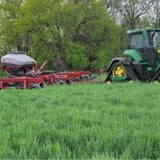
The concept seemed radical—plant soybeans into growing cereal rye, wait 40 days until the rye reaches anthesis (the flowering stage when it's dropping pollen), then roll everything down. At this stage, the soybeans are still small and flexible, only a few inches tall, while the mature rye towers above them at 4-5 feet. When the heavy roller crimps the rye stalks and lays them flat, the young, resilient soybeans simply bend with the roller and stand back up once it passes, unharmed. Meanwhile, the crimped rye is terminated, creating a thick natural mulch layer that suppresses weeds and retains moisture.

Rick tested the system on 200-300 acres the first year he tried it. Initially, he made a post-emergence herbicide pass "just to be sure." The next year, he expanded to 1,000 acres without any chemical applications—and it worked.
Success with the roller crimper enabled Rick to begin the transition to organic, but going organic was driven by something deeper. He began reflecting on his family's health history: an uncle lost to prostate cancer, a sister-in-law battling cancer, his wife diagnosed with Stage 4 breast cancer at just 30, and his nephew facing non-Hodgkin lymphoma at only 23.
"You really look at things differently because when you're in the first part of your journey, you're impervious to everything," Clark explains. "I didn't go organic because of the price. I went organic because of building human health—both nutrient density and taking harmful products away from human touch. I did not want my children or grandchildren being around these skull-and-crossbones chemicals any longer."
The Diversity Revelation
In the summer of 2024, Rick experienced a humbling moment that would reshape his understanding of soil health. When renowned ecologist and agronomist Dr. Christine Jones visited his farm, she gave Rick some unexpected feedback. As they were walking into what appeared to be a beautiful field of hairy vetch growing with corn, she exclaimed "Oh my gosh, this is just a single legume growing here!"
Rick's heart sank. Despite the field looking healthy, the lack of plant family diversity had left a compaction layer just two to three inches below the surface—something the single-family root system couldn't penetrate. The problem? A lack of diversity—specifically, diversity of plant families.

This insight proved transformative. Every legume—from alfalfa to clover to vetch to peas—belongs to one plant family. Every grass—oats, barley, sorghum, millet, corn—one family. All the brassicas—radishes, turnips, collards—one family. A farmer could have a 15-species mix but still only represent three plant families. "It's not about the number of species," Rick emphasizes. "It's about how many plant families are in the mix. They're put into different families because they have unique characteristics. That's what we want—uniqueness coming to the party."
Building the Ultimate Cover Crop Cocktail
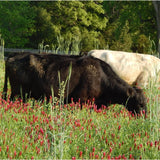
Working with Keith Berns and Green Cover, Rick developed a diverse cover crop cocktail that represented seven plant families—a dramatic increase from the typical three-family mixes. The cocktail included clover, faba beans, and sunn hemp from the legume family (Fabaceae); oats and triticale from the grass family (Poaceae); sunflowers and safflower from the aster family (Asteraceae); radish from the brassica family (Brassicaceae); flax from the flax family (Linaceae); buckwheat from the buckwheat family (Polygonaceae); and phacelia from the borage family (Boraginaceae). The cocktail was planted after wheat harvest and the results were extraordinary in terms of biomass production, root growth, and biological diversity, with the diverse root systems breaking through the compaction layer that had plagued the field

Moving forward, Rick isn't satisfied with just seven families. His goal is to work with Green Cover to reach ten or more plant families, incorporating additional species like sesame, okra, sugar beets, and dill. Each plant family contributes unique root exudates to feed different microbial communities in the soil.
"This is not about growing the biggest, baddest biomass you can grow," Clark notes. "This is about getting everything working in harmony and getting that mycorrhizal network going."
Beyond Corn-Soybean
For Rick, achieving true diversity also requires breaking free from the conventional corn-soybean rotation. Rick's operation now includes corn, soybeans, wheat, alfalfa, peas, milo, buckwheat, cover crops, sheep, and cattle. This rotation creates opportunities to establish diverse cover crop cocktails in late summer—the optimal window.
"You cannot do that in a corn-bean rotation," Rick states plainly. "This cocktail needs to be planted by the third week of August at the latest—ideally the second week."
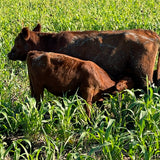
Rick employs three strategies to establish diverse summer cover crops. The first option is planting immediately after small grain harvest, taking advantage of the July or early August window when soil moisture and warm temperatures favor rapid establishment. The second approach involves coordinating cover crops with his livestock rotation, strategically timing plantings when cattle move off grazing fields to free up land for summer cover crop establishment. The third strategy is taking fields through a "regen year"—dedicating an entire season to cover crops and cattle grazing without any cash crop production, allowing the soil biology to rebuild and recover before returning to crop production.
Looking Forward
Always the innovator, Rick wants to continue pushing boundaries. He's planning to integrate the "three sisters" system—the traditional Native American intercropping method where corn, beans, and squash grow together in symbiotic relationship—alongside other companion cropping trials with buckwheat and flax planted into corn.
"We have to understand how to co-mingle these crops together," Clark says, "and either find a buyer that will buy that intermixed product or get a cleaning system to separate them. That is the future of where we're going to take this regenerative movement."
For Rick, diversity extends beyond plant species and families. It encompasses cash crop rotation, including annuals and perennials, incorporating warm-season and cool-season species, integrating livestock, and surrounding himself with diverse perspectives from other farmers and experts.
"Diversity is everything—it's all-encompassing," he reflects. "When you think about what we're trying to accomplish today, we are trying to remember everything we have forgotten about farming. What we're trying to do today is what was being done 80 to 100 years ago."
"The success of next year's cash crop starts with the success of this year's cover crop." - Rick Clark
Advice for Getting Started with Regenerative Farming
Clark's advice for those starting on the regenerative path is measured and practical: start small with two or three species in your cover crop mix, understand your termination method before planting, and never jeopardize the livelihood of your farm with overly aggressive changes.

"You cannot just all of a sudden go to a conference and be excited and say, 'Hey, Rick said we're going to eliminate inputs. Let's just go do it tomorrow.' No, it doesn't work like that. We've got to go slow and make sure that farm is still there tomorrow."
Most importantly, he emphasizes one guiding principle: "The success of next year's cash crop starts with the success of this year's cover crop."


Richard Dunn
September 09, 2026
Would like to plant a spring food plot mix .
I live in AR lower ozarks very rocky sand thin soil . Full sun and heavy shade . Need drought
Resisting plants for full sun and shade not planting but about 1 acre 50 /50 full sun to heavy shade each plot about 1/4 acre . Will have to broadcast and roll it in . What would you suggest .