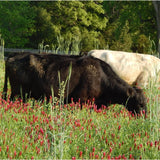
It Is Possible
How Michael Detweiler Is Transforming Rocky Ground Into Fertile Pasture
As he works to transform the rocky Ozark plateau into an abundant grazing land with nothing other than water buffalo, beef cattle, and cover crops, Michael Detweiler’s motto is, “It is possible.” The transformation is even more notable, considering Michael is a chiropractor who left his practice of 30 years to manage the 4,000-acre water buffalo and cattle ranch owned by Jordan Rubin, author of “The Maker’s Diet: Patient Heal Thyself,” and numerous other books. Their collaboration is a testament to the importance of lifelong learning and demonstrates that outsiders can have a huge impact on the agricultural landscape.

The thin, rocky soil of the southern Missouri Ozarks is not what Michael grew up with. Originally from central Illinois, where ample deep black topsoil and few, if any, rocks is the norm, Michael now contends with so many rocks that tillage isn’t even an option. While the area historically receives 42” of rain per year, the locals will tell you, “We’re only two days from a flood and two weeks from a drought.” Despite the challenges of this region, Michael’s management is helping to build the soil and increase organic matter on the operation. Three years ago, owner Jordan Rubin embarked on a mission to improve the overall health of the land and the ecosystems around it. This included a 7-year study in collaboration with the Rodale Institute using Allan Savory-style rotational grazing while testing 35 different soil health indicators including soil organic matter testing and PLFA tests. No-till drilling cool and warm season cover crops into Kentucky 31 Tall Fescue pastures vigorously began in the fall of 2021. Three years later, they are already seeing dramatic changes on the land.
What’s With the Water Buffalo?
Michael admits water buffalo are an uncommon species to raise, but in his words, “Jordan likes unique things.” Worldwide, there are only about two million individual water buffaloes, and nearly 400 of them live under Michael’s care. While the water buffalo are certainly not native to the climate and environment of the Ozarks, they have adapted well. Their larger foot size holds up in wet environments, an important trait where the annual average rainfall is over 40”. Michael not only uses the water buffalo to harvest what he plants, but also to “till” the soil. Water buffalo hoof action helps to incorporate the residual ungrazed and dead plant material back into the soil. They are slower maturing animals compared to cattle, and possess a slower working rumen with a significantly higher microbial population and diversity. This allows water buffalo to utilize stemmy and lignified plant material from more mature forage that cattle generally won’t touch. While many people select water buffalo for milk production, Michael is more concerned with meat production. In addition to the water buffalo, Michael stocks some more common livestock species such as goats to help control brush, and feathery friends such as ducks and chickens to eat unwanted insects.

Cover Crops for the Win
Michael ranches in an area dominated by Kentucky 31 Tall Fescue (K-31), an introduced cool season grass that causes health issues in livestock due to the toxic endophyte in the plant. In an effort to increase forage diversity and transition away from a K-31 monoculture pasture without chemicals, Michael has turned to diverse annual cover crops from Green Cover. The cover crops provide forage for the livestock while helping to thin the stands of the fescue. While conventional tillage is not an option, Michael uses the livestock and a 10-foot Great Plains drill to seed about 600 acres of pasture twice a year. Planting a little bit at a time makes this job less daunting. Michael is a firm believer that you don’t have to have big, fancy equipment to make this work: you just have to be willing to compromise, be innovative, and try new things. Planting highly diverse cover crops at high seeding rates encourages the growth of diverse forages and provides abundant forage for the summer fescue slump. This diversity also mitigates the potential effects of the endophyte in K-31. The early test results are starting to show factual evidence for the fast improvements that cover crops and biology can make. “This geographic area has an average organic matter percentage of 1-2%. Our most recent soil samples show 4.0-4.5% and we’re not done yet”. With more carbon in the system, there’s more food to go around, stimulating plants and critters alike! In fact, the farm saw a threefold increase in soil biology in the top three inches. Michael recalls, “The lab actually called our soil scientist to make sure it was the same farm!”

With the biology population and species counts moving up dramatically, more plant species are being ushered in, and the future is looking very bright. Various native warm and cool season species of plants are making an appearance on the landscape again as well! Switchgrass and Big Bluestem, native warm-season grasses, are making a comeback in various pastures across the ranch! “The goal, in addition to native forage species naturally expressing themselves in the pastures, is interseeding selected pastures with a native warm season blend soon. The cover crops are helping us make that transition from fescue dominant pastures to more diverse and productive pastures.” Michael recalls that when he started, the ground cover was only 50-60%. Now they are seeing 90-100% ground cover in many places. Any livestock producer would agree that more ground cover means more forage, and more forage means happier critters. And the water buffalo aren’t the only happy critters: 70 different bird species can be found dwelling on the property, many of which are not seen on other operations nearby. The below-ground animals are thriving too! “Three years ago, I would find 2-3 worms in a shovelful of soil,” recalls Michael. “Now I find 18-30 worms in one shovel full.”
The Six Greats
Michael credits the operation’s success to six “greats”. “People ask me if it’s possible to integrate cover crops into the fescue pastures of the Missouri Ozarks. I say YES! We are firm believers in godly stewardship. It takes a great God, great faith, great counselors, great seed, a great team, and great livestock to make it happen. Keith and Davis [of Green Cover] have been great counselors when it comes to cover crop mixes and the timing of planting. The Rodale Institute and SnapLands, LLC have also provided priceless guidance during the regeneration process. It’s true that any endeavor like this takes a village, people with different strengths coming together to build something fantastic.”
Don’t Be Afraid to Look Different
It goes without saying that regenerative agriculture practices definitely stand out from conventional methods. A pasture of highly diverse, super nutritious cover crops might look like a disaster to the neighbors at times, but Michael is no stranger to this, and he doesn’t let it bother him. “I don’t think you’re doing well unless someone is asking what you are doing,” he chuckles. In one instance Michael even persuaded a neighbor to try something that hadn’t been done since his grandfather was farming. “I had a few neighbors ask about the millet I had planted in one of the pasture mixes. They said they remembered when their grandfather would plant millet and vetch. The next year they had fields planted to millet and vetch.” This is a great testament to leading by example and humbly sharing your story. “Don’t be afraid to look different from the crowd, be bold enough to take a leap. Do, look, and be different. Who cares what the critics say—some day they might get brave and ask you what you’re doing. Always remember, it is possible!”