Sowing the Seeds of Profit
Jeff Steffen Makes a System of Farming Profitably
In northeast Nebraska, where farmers once grew diverse rotations including lots of oats, nearly every field is locked into growing corn and soybeans in a two-year oscillation. But Crofton, Nebraska farmer Jeff Steffen and his wife Jolene take a different approach that integrates more diversity. A third of Jeff’s rotation is devoted to small grains, which give him a lot of flexibility and the ability to integrate livestock and diverse cover crop mixes. When Jeff does raise corn, he uses non-treated seed, and also experiments with interseeding cover crops. During the soybean portion of the rotation, he uses non-GMO varieties and drills the soybeans into green cover crops. The Steffen farm also grows buckwheat, peas, and cereal rye for seed production, but his favorite crop to grow is oats.
While most of the neighbors no longer grow oats because they don’t think they are profitable or they’re worried about disease pressure, Steffen is growing a healthy and profitable crop. “We’re convinced the health of the oats is a result of what we have in our rotation… Having that cool season crop, we can go to warm season annuals after oats and graze them. And we’ve been able to show that, actually, you can have a quite productive farm when you farm that way.”
According to Jeff, it’s the diverse cover crops that supercharge his system. Jeff uses Green Cover’s SmartMix® calculator to design mixes with the amount of different species he’s looking for. This diverse cover crop is Jeff’s chance to get the regenerative cycle going. “When you can get this kind of growth, and with this much diversity, this will have a positive tail for several years for what it does to the soil.”

To further bolster profitability and as a hedge against low commodity prices, Jeff has introduced annual grazing into his rotation, where the only crop he grows on some cropland fields is forage for cattle. “We want to have some fall planted cool season cover crops to graze in the spring and then plant full summer cover crop blends that do not include corn because we’ll likely rotate to corn the following year.”
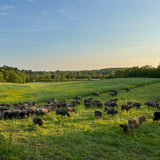
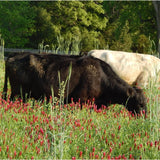
“So after growing all that cover crop forage, we generally harvest about half of it through our cattle.” Jeff’s extended family also have cattle operations, so he never has a problem getting the number of cattle he needs into his fields. “We’ll generally have cows all winter on various fields and in most years they need next to zero hay.” Even when there is snow on the ground, the cows are out in the field earning their own living by grazing through the snow. “This past winter, the only hay we fed was during blizzards.”
Jeff sees weed control benefits from the diversity and the livestock integration in his operation. “After having cows process and trample 3-5 tons of cover crop biomass through the wintertime, it’s just amazing how much weed suppression this has.” The combination of ground cover and supercharged biology from the animals creates a soil environment where weeds are not welcome or needed.
Jeff also sees benefits in disease resistance from his rotation. “We’ve been finding with our extended rotation, even when you have weather that causes disease, we’re having very little. We have not applied any insecticide or fungicide since 2011, and we have never applied fungicide on oats.”
A Focus on Profitability Rather Than Revenue
To put some hard numbers to his approach, Jeff works with the University of Nebraska-Lincoln (UNL) on his crop budgets. These charts compare actual results from his 500-acre rotation in 2023 versus the crop budgets recommended by UNL for corn and beans with traditional inputs. For the revenue column, even though he sells most of his small grains as seed, Jeff is figuring the just value of the grain before it goes into the seed enterprise.

Jeff says “My revenue is generally lower… and we’ve been seeing this for close to 10 years now, but my cost of production is so much less. With our system, we can lower our inputs by $150-$250 an acre. This system takes a lot of the pressure off of needing to have the revenue high. For this past year, the net per acre is quite a bit higher than if we were just raising corn and beans..”
Even with recent lower prices for small grains, Jeff is committed to growing oats. “I almost look at that as being a regenerative part of the system… Our costs per acre are still so much lower. You can see we’ve come up with a prediction of a pretty good net profit. Anybody that’s been running budgets on corn and beans for 2024, knows that it doesn’t look really good and the likelihood of being profitable is very low.”

Jeff encourages people to try planting forage in the spring and following it up with a multispecies blend in the summer, especially when commodity prices are low. “Once you see what that does to your system, then you get excited and you want to get it into there more there are real opportunities for summer annual grazing for profitability.”
Results in the Data
Always the student, Jeff continually has research and comparison plots on his farm. “I like to run small plots of different oats varieties, sometimes more for observation than even the hard data.” Jeff will harvest some replications by hand and use digital scales to get estimates on dry matter and grain yield.
After listening to Green Cover’s webinar featuring John Kempf talking about the differences in seed grown in regenerative environments, Jeff began thinking about the seed that he has been growing. He wanted to know, “Is the seed that we are producing different? Is it better than what people can buy elsewhere?” One way that Jeff is evaluating the seed quality is by looking at the nutrient levels of the seed. In 2022, Jeff had a nutrient analysis taken on an oats crop before they were cleaned for seed. By comparing this to what published feed tables consider the average composition of oats, Jeff was able to see results. “In a system with very low fertility added, we had protein levels higher than what is considered average. Our phosphorus level was 133 percent of average. We did GPS coordinated grid sampling of the soil where this oats came off of and the phosphorus levels in these soils are extremely low. They are in the single-digits, but we still have phosphorus in the oats well above average. That tells me that the biology in our system is really working.”

Regarding this comparison, Jeff says, “It all starts making you think… if there’s really big differences in the seed quality across the industry, it makes sense that the more nutrients we have in the seed, the healthier the plant will be that grows from that seed.” Jeff also sees a difference in test weights which is another indicator of seed quality. “The test weight this year was right at 40 pounds, which is 25% above the industry standard of 32 pounds per bushel.” This test weight leads to larger and heavier seeds at 12,000 seeds per pound, where normally oats are around 15,000 seeds per pound.
It makes sense that the more nutrients we have in the seed, the healthier the plant will be that grows from that seed.
Benefits of an Extended Rotation
When Jeff considers all of the benefits of his diverse rotation, one of the most important aspects is water infiltration and moisture holding capacity. These two pictures (below) were taken minutes apart, a mile apart after very heavy rainfall this past summer. “30 years ago, [this field on the right] would have been overwhelmed with water from the upland, like this field on the left a mile away. We have very little runoff from the upland anymore. And also the quality of the soil is so much better on this field that you can really see how it shouldered this heavy rain event.” Jeff also sees a difference in the dry years, where his soil doesn’t blow away in the wind.


Jeff Steffen’s innovative approach to farming in northeast Nebraska exemplifies the profound impact of diverse crop rotations and integrated livestock management on both profitability and sustainability. By challenging conventional practices and embracing a more holistic farming system, Jeff not only enhances his farm’s resilience to environmental pressures but also improves soil health and crop quality. His commitment to regenerative agriculture demonstrates that profitability doesn’t solely rely on high revenue, but rather on strategic input management and ecological balance. As farmers face increasing uncertainties in commodity markets, Jeff’s success serves as a powerful reminder of the benefits that come from embracing diversity in farming practices. By prioritizing sustainability and adaptability, Jeff is not just cultivating crops; he is nurturing the very foundation of agricultural prosperity for the future.