Alfalfa and Fescue vs. Corn Silage: Real Cost Comparison
Daniel Mushrush ranches near Elmdale, Kansas in the heart of the Flint Hills. While most of the region is native grassland, there are rich river bottomlands that are used for growing corn. A couple years ago, after doing the math, Daniel decided to stop using his river bottom for corn silage and planted it to a combination of alfalfa and Estanchia novel endophyte tall fescue. Of course, this “radical” move caught the attention of his neighbors, as the bright green field was a stark contrast in the winter to the bare ground of the harvested corn and soybean fields. One day last spring, Daniel entered the local morning coffee and gossip gathering place and was accosted by the group.
“Bet you feel pretty stupid now because you planted all that good bottom ground to grass and now corn is $6 a bushel!”
“No, I am feeling pretty smart right now, actually”
“Huh? But you could be growing $6 corn instead of grass!”
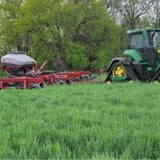
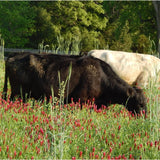
“Well, I use that land to graze and feed my cowherd in the winter. I used to chop silage. When corn goes to $6 the cost of seed corn, fertilizer, herbicides, fungicides and equipment goes up. Silage costs $400 an acre to put in, and another $200 an acre to chop and put in a bunker. That is already $600 an acre. Now that I have alfalfa and grass, I don’t have to buy $300 a bag seed corn, or any seed, because the perennials last for years. I don’t have to buy nitrogen because the alfalfa makes it for me for free. I don’t have to buy phosphorus or potassium fertilizer, because grazing recycles all those minerals back to the soil. I don’t have to buy herbicides or fungicides or insecticides, because I don’t have problems with weeds, diseases or insects. And I don’t have to pay a chopping bill or fire up a tractor every day because the cows do all the harvesting themselves. I get about the same tons per acre as when I raised silage, but it costs me several hundred dollars per acre less to do it. And when the river comes out its banks, my soil stays in place while a lot of your soil in the corn and bean fields washes away. So, yeah, I feel pretty smart right now.”
The coffee shop went pretty quiet for a bit while those words soaked in like spilled coffee on a paper towel.
Think about it. A typical yield of corn silage in southeastern Kansas is about 20 tons per acre, at 35% dry matter, for a total yield of 7 tons per acre. Fermentation and spoilage will take at least 20% of the stored energy so 7 tons ends up being 5.6 tons of actual feed. A good perennial alfalfa and grass combination can normally produce 5 to 6 tons an acre, and like Daniel told his coffee shop buddies, you don’t need to buy seed every year, or nitrogen fertilizer, or phosphorus or potassium, or herbicide or fungicide, or insecticide, or pay for that chopping and packing or feeding equipment!
Having a novel endophyte fescue in the mix provides a forage that retains excellent nutritional value even in the dead of winter, so this mix provides feed at the exact as stored silage.
But while Daniel is happy with his fescue and alfalfa, he is not yet convinced that he is maximizing his potential of those acre. His stand is still young and has not yet filled in to form a solid stand; it should increase in productivity over the next year or two. It may also be possible to introduce some other species to gain some additional production. This summer, he also tried interseeding summer annuals (sorghum, sunflowers and sunnhemp) into his fescue in late June to try to grow some additional biomass that would persist into the winter and add some biologically fixed nitrogen as well as enhanced soil health benefits. Despite a prolonged summer drought, the interseeded crops did manage to grow well above the summer growth of the fescue and did add to the total amount of grazeable biomass. Comparing the costs of corn silage versus stockpiled pasture to feed cattle in the winter not only makes you realize why Daniel is feeling smart these days, but also makes you wonder why more people don’t follow his example so they can feel pretty smart as well!