Understanding 45Z Carbon Credits: How to Get Paid for Soil Health Practices
This article is an AI summary based on episode #37 of the Green Cover podcast.
Four years of waiting is over. On June 26, USDA released the final guidance for the 45Z Clean Fuel Production Credit, and for the first time, farmers growing corn, soybeans, sorghum, or spring canola can get paid based on how they grow their crop.
We talked with Mitchell Hora, seventh-generation Iowa farmer and founder of Continuum Ag, to break down what 45Z actually is, how the money moves, and what you need to do right now.
What 45Z Actually Is
45Z is a transportation biofuel tax credit from the Inflation Reduction Act, aimed at lowering the carbon footprint of ethanol, biodiesel, renewable diesel, and sustainable aviation fuel. It started January 1, 2025, and runs through 2029.
Every bushel gets a Carbon Intensity (CI) score — a default carbon footprint number set by the government. The new default is 27.4 for corn and 22.3 for soybeans. The lower your score, the more valuable your crop is to a biofuel plant, because the plant earns bigger tax credits for lower-carbon fuel.
How the Money Flows
The credit itself goes to the ethanol or biodiesel plant, not straight to you. Here's the chain:
- You document your practices — cover crops, tillage, nitrogen use, yield.
- That data gets packaged into a CI certificate through a verification platform.
- The certificate travels with your crop into the supply chain.
- The plant uses your certificate to lower its overall CI score and earn tax credits.
- The plant shares some of that value back with you.
For every 5 points a plant lowers its CI score, it earns about 10 cents a gallon — roughly 30 cents a bushel in total shareable value. How much of that reaches you depends on the plant. Hora estimates farmers doing cover crops and no-till could see 15 to 50 cents a bushel, which could add up to $75 to $100+ an acre on corn. Soybeans are lower — think $20 to $50 an acre.
What Actually Moves Your Score
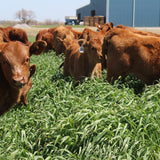
- Cover crops — worth roughly 9 to 10 points. The single biggest lever. Grazing your cover crop is now allowed and barely dings your score.
- No-till — a strong second driver, worth 15 to 25 cents a bushel on its own.
- Nitrogen efficiency — every 20 units of nitrogen you cut is worth about 1 point, as long as yield holds. Nitrification inhibitors and stabilizers help here too.
- Manure — used to matter a lot in the old calculator. Not much anymore.
There's no checkbox for biologicals or biostimulants — the program just rewards the outcome, so however you get your nitrogen efficiency up counts.
What You Need to Document
The data is the value. If you can't prove a practice happened, it doesn't count toward your score. Keep:
- Cover crop planting date, rate, species, and termination method
- Fertilizer type, rate, and timing
- Receipts, as-applied maps, and photos
- Yield and harvest records
Every farm bundled into this program goes through an ISO-accredited third-party audit, and only a portion of farms get a full site visit. It's not scary, but it does mean your records have to hold up.
What's Off the Table
You can't double-dip. If you've already sold a carbon credit or offset on a field, that field is disqualified from 45Z. Cost-share programs like EQIP and CSP are fine to stack with it — just not a separate carbon program.
What to Do Right Now
If you sold corn or soybeans into the biofuel supply chain in 2025, you already have skin in this game. Here's the short list:
- Get your CI score. It's free at topsoil.ag and takes about 15 minutes.
- Ask your buyer if they're participating. If they're not on the ball yet, point them toward Continuum Ag.
- Gather your 2025 records now — fall 2024 cover crops, fertilizer, tillage, and harvest data. This window is open through roughly April 2027.
- Decide field by field. You don't have to enroll every acre — just the ones going into biofuel with a good score.
This program rewards practices a lot of us are already doing. The work now is proving it. Run your score, see what it's worth, and decide if the juice is worth the squeeze for your operation.
Questions about building a cover crop plan that fits into your 45Z strategy? Reach out to Green Cover — we'll help you find the right mix for your ground.